Most athletes think in-season is all about maintaining.
But if you structure it right, you can actually get stronger, build muscle and improve your performance while you're competing.
Here's proof.
One of our athletes added 40kg to his box squat in under four months — all in-season.
At the start of the year he was lifting 100kg for six reps. He's now hitting 140kg for two.
That didn't happen by accident.
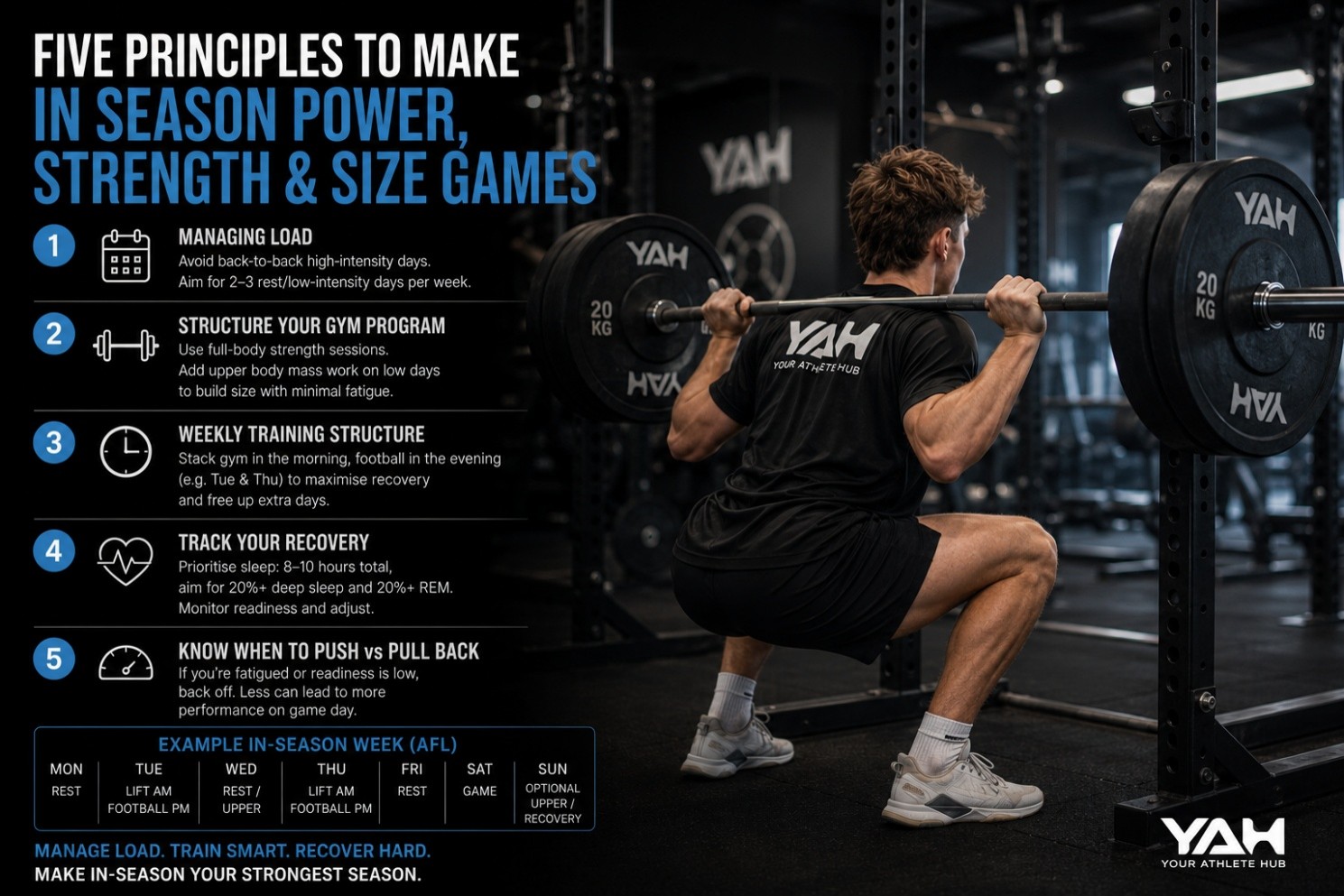
Here are the five principles we used to keep him progressing while staying strong, powerful and resilient.
1. Manage your load
Too much running and extra skills work will quietly kill your progress. The fix is structuring your week properly.
If you've got two hard sessions back to back — running and gym — make sure a rest day follows.
As a rule, we like two to three days of work, then a low-intensity or full rest day to recover.
For me, that's at least two rest days a week: usually one around Wednesday, and one on Sunday.
2. Structure your gym program
In-season, balance beats splits. Full-body strength sessions are the most efficient way to keep building without frying yourself.
And if you're chasing a bit of extra mass, slot it into a lighter day dedicated purely to upper-body work.
That way you're adding size while carrying minimal fatigue into your games.
3. Get your weekly structure right
How you stack your days matters as much as what's in them.
Where we can, we'll pair gym in the morning with football in the evening on the same day — say a Tuesday and a Thursday.
Doubling up like that frees up more days across the week for genuine recovery, which is a game-changer if you're training or playing more than three days a week.
4. Track your recovery
You can't manage what you don't measure, and sleep is the marker I care about most — specifically deep sleep and REM.
As a rough guide, aim for around 15–20% of your night in deep sleep and 20–25% in REM.
Your total should sit above eight hours, and it can stretch closer to ten depending on how heavy your training load is.
5. Know when to push and when to pull back
Training hard at the wrong moment doesn't build you up — it compromises your game-day performance.
If you're feeling fatigued and flat at sessions, or a wellness or readiness check at your gym is telling you you're cooked, then backing off or taking the day is the smart play.
Learning when to push and when to pull back will take you a long way.
The in-season blueprint
Here's how we'd structure a typical in-season week for an AFL player:
Monday — Rest
Tuesday — Lift + football
Wednesday — Rest or light upper body
Thursday — Lift + football
Friday — Rest
Saturday — Game
Sunday — Optional upper body and/or recovery
In-season doesn't have to mean treading water.
Manage your load, train with intent and recover properly, and you can make serious athletic progress — just like our athlete did, and plenty of others have.
Want to go deeper? Head over to Episode 40 of the Your Athlete Hub podcast.
LATEST ARTICLE
All Articles
Five Principles to Make In-Season Power, Strength & Size Gains: The Athlete Blueprint
Back 2 MIN READ Most athletes think in-season is all about maintaining. But if you structure it right, you can
STRENGTH & CONDITIONING

Athletic Benchmarks to Get Drafted at 18: A Sport-by-Sport Breakdown
Back 3 MIN READ Most young athletes who don’t get drafted aren’t unfit. They just don’t know what elite actually
STRENGTH & CONDITIONING
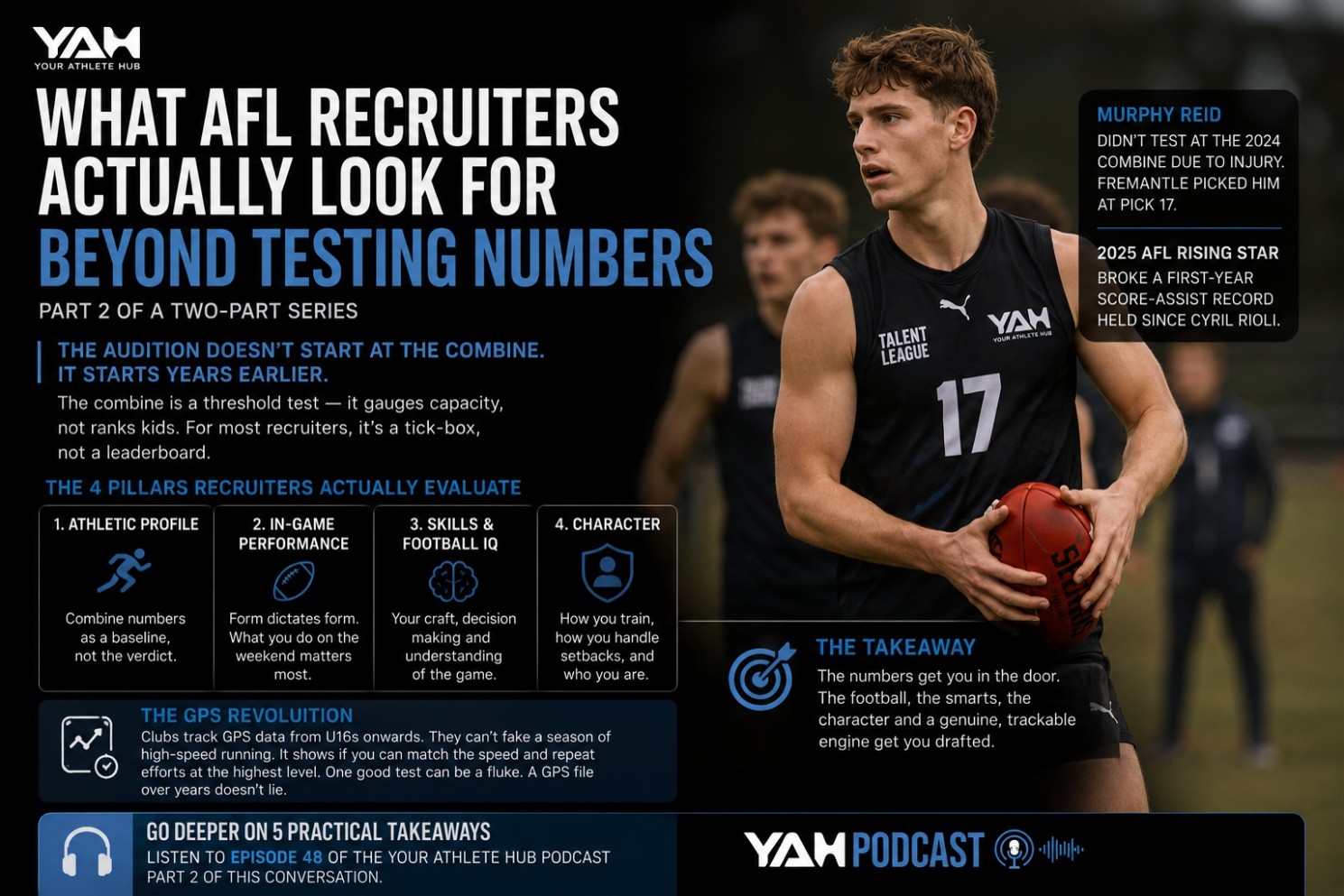
What AFL Recruiters Actually Look For Beyond Athletic Testing Numbers
Back 2 MIN READ Every year, a kid smashes the combine and doesn’t get picked. And every year, a kid
STRENGTH & CONDITIONING
READY TO LEVEL UP YOUR PERFORMANCE?
Don't let cash flow challenges hold your business back. Get expert guidance and proven strategies to optimise your financial performance.